
How a fixed loan payment is calculated
A fixed loan payment uses the amount borrowed, the monthly rate, and the number of months. Here is the formula, a $10,000 example, and what the estimate leaves out.
A fixed loan payment is the amount that would pay a borrowed balance down to zero over a set number of months, if the rate never changes and every payment is made on time. The loan payment calculator on this site uses that standard fixed-rate formula. It is an estimate of the payment, not a lender's offer.
The payment formula
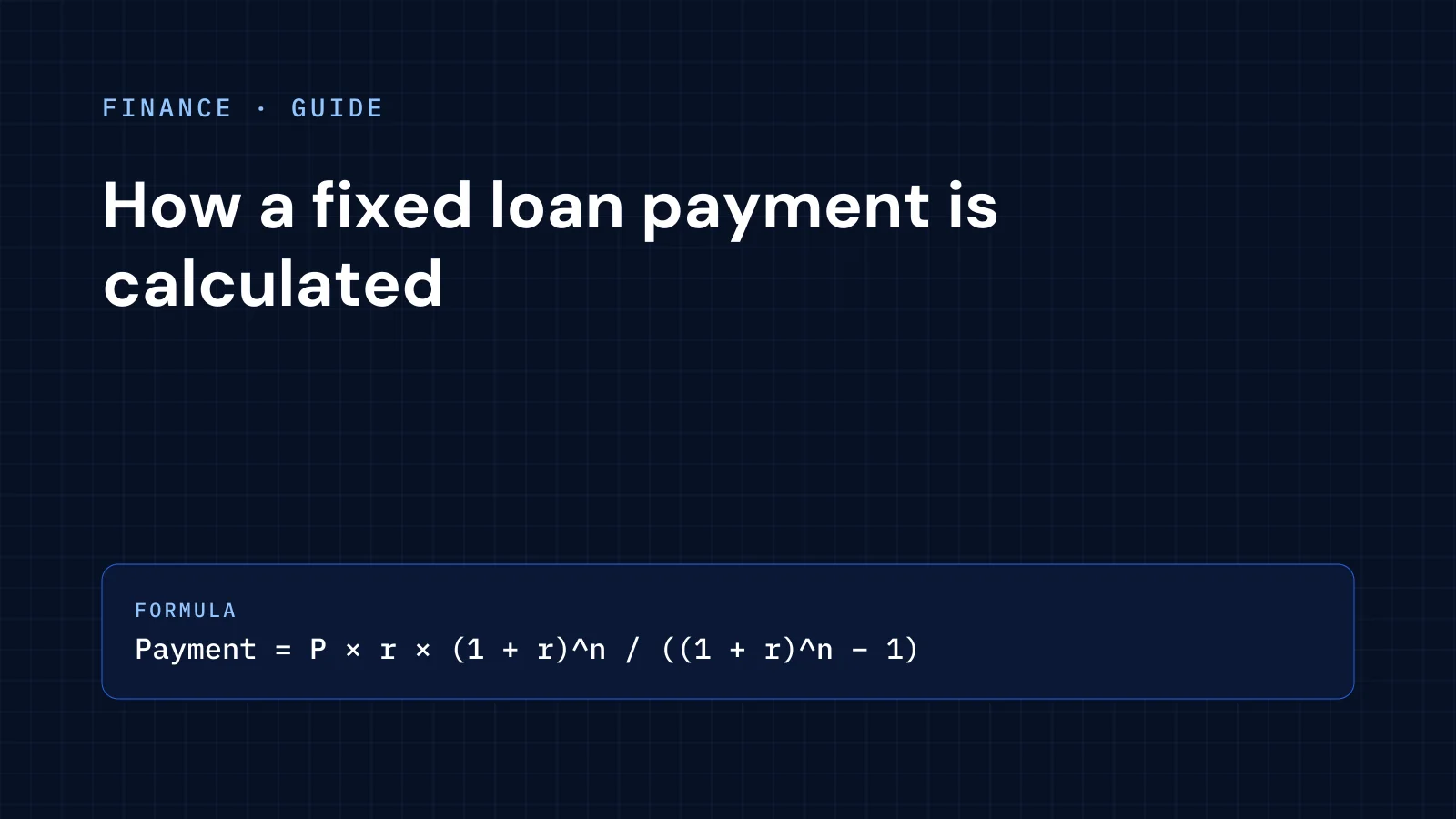
The monthly payment is P times r times (1 + r) to the power of n, divided by (1 + r) to the power of n minus 1. P is the amount borrowed. r is the annual interest rate divided by 12. n is the number of monthly payments. At a zero rate, the amount is split evenly across the months.
What you need to enter
- Loan amount: the principal you borrow, before fees.
- Annual interest rate: the fixed yearly rate. It is not an APR that already folds in fees.
- Term: years, plus up to 11 extra months. The calculator turns that into n, the number of months.
A worked example
Take a $10,000 loan at 6% a year for 5 years. The monthly rate is 0.06 divided by 12, which is 0.005. The term is 60 months. The fixed payment comes out to $193.33. Early payments are mostly interest. Later payments put more of that same $193.33 toward the principal. The last payment clears any remaining cents after rounding.
What this estimate leaves out
- Origination fees, insurance, and taxes are not added to the payment.
- Extra principal payments are not assumed, so the term does not get shorter by itself.
- A variable rate, a daily interest method, or a lender's own rounding can change the figure.
Loan payment calculator
Enter an amount, a fixed annual rate, and a term to see the monthly payment.
Open Loan Payment Calculator →